Table of Contents
- Start With the Type of Ice Maker Problem
- When Ice Maker Repair Is Usually the Better Choice
- When Replacement Is the Smarter Long-Term Decision
- Ice Maker Repair Versus Replacement: Costs Beyond the Invoice
- Signs the Problem May Not Be the Ice Maker
- Questions That Lead to a Better Decision
- Get an Answer Before You Buy a New Appliance
A refrigerator that stops making ice can turn a normal week into a string of small frustrations. Drinks are warm, coolers need bagged ice, and hosting family or friends becomes more work than it should be. Ice maker repair versus replacement is not always a simple price question. The best choice depends on what failed, how old the appliance is, and whether the rest of the refrigerator is still serving your household well.
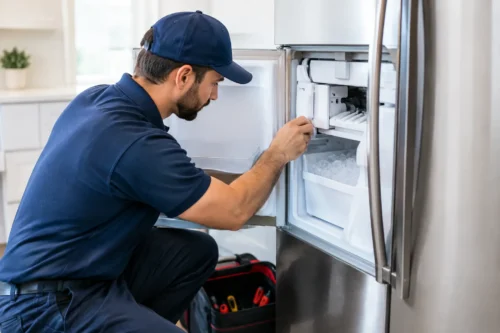
Before replacing anything, get a clear diagnosis. Many ice maker problems come from a single serviceable part, not a completely failed system. A trained technician can identify the source of the trouble and help you avoid paying for a replacement you may not need.
Start With the Type of Ice Maker Problem
An ice maker relies on several systems working together: cold freezer temperatures, a water supply, an inlet valve, a filter, electrical controls, and moving components that harvest and eject the ice. When one part falls out of line, the symptom can look more serious than it is.
For example, no ice production may be caused by a clogged water filter, a kinked supply line, a failed water inlet valve, or a freezer that is not cold enough. Small, hollow, or cloudy cubes can point to restricted water flow. A tray that fills but never dumps ice may have a problem with its motor, heater, control module, or sensor.
In Southern Utah, mineral-heavy water can also contribute to buildup in supply components over time. That does not automatically mean the ice maker needs replacing. It does mean the cause should be checked carefully rather than guessed at.
When Ice Maker Repair Is Usually the Better Choice
Repair is often the practical path when the refrigerator is in generally good condition and the failure is limited to one identifiable component. A broken fill valve, worn shutoff arm, faulty sensor, damaged wiring connection, or failed ice maker motor can often be repaired without replacing the entire refrigerator.
Repair also makes sense when the appliance is still relatively young. If the refrigerator cools consistently, its doors seal properly, and it has not needed repeated major repairs, a targeted ice maker repair can restore an important convenience at a reasonable cost. Replacing an entire refrigerator because of one failed ice maker part is rarely the first move homeowners need to make.
A repair can be especially worthwhile for built-in, counter-depth, or higher-end refrigerators. These units are expensive to replace and may require careful sizing, cabinet adjustments, or matching finishes. Fixing the ice maker may protect a much larger investment.
The quality of the repair matters. Replacing a part without confirming why it failed can create another service call later. For example, installing a new ice maker will not solve a temperature issue, poor water pressure, or a failing control board. A proper diagnosis looks beyond the first visible symptom.
When Replacement Is the Smarter Long-Term Decision
Replacement becomes more reasonable when the ice maker has reached the end of its usable life, parts are discontinued, or multiple components have begun failing. This is particularly true for an older refrigerator with cooling problems, water leaks, loud operation, or repeated electronic issues in addition to the ice maker trouble.
A useful guideline is to compare the estimated repair cost with the condition and remaining life of the full appliance. If a repair is costly and the refrigerator is already near the end of its expected service life, putting that money toward a new unit may be the better value. There is no one percentage that fits every household, though. A modest repair on a reliable refrigerator can still make sense, while the same repair on an unreliable unit may not.
Replacement may also be necessary when the correct parts are no longer available. Some older ice maker assemblies, control boards, and specialty components cannot be sourced reliably. In that situation, a technician should be straightforward about whether a repair is durable or merely a temporary workaround.
For a standalone ice maker, the decision can be different. Compact and lower-cost units are sometimes less economical to repair because labor and parts can approach the price of a new machine. Premium undercounter models are another story. Their cost and installation requirements often make a well-executed repair worthwhile.
Ice Maker Repair Versus Replacement: Costs Beyond the Invoice
The lowest immediate price is not always the lowest cost over time. A replacement refrigerator may use less energy or offer a more dependable ice system, but it also brings delivery, installation, water-line connection, and disposal considerations. Some homeowners also face the added cost of modifying cabinetry or finding a model that fits an existing kitchen layout.
On the other hand, continuing to repair an appliance with frequent breakdowns can become frustrating and expensive. A family should not have to plan meals around whether the refrigerator will hold temperature or whether the ice maker will work before a weekend gathering.
Think about how the appliance affects your routine. If your ice maker is the only concern and the refrigerator is dependable, repair often protects both your budget and your convenience. If ice production is just one of several recurring problems, replacement can provide more peace of mind.
Signs the Problem May Not Be the Ice Maker
Homeowners sometimes assume the ice maker itself has failed when the real issue is elsewhere. Check the simple items first: make sure the ice maker is switched on, the water supply valve is open, and the filter is not overdue for replacement. Then pay attention to the refrigerator’s overall performance.
If food in the freezer is soft, frost is building up excessively, or the refrigerator seems to run constantly, the ice maker may be reacting to a cooling or airflow problem. Ice makers generally need a freezer temperature near 0 degrees Fahrenheit to operate correctly. A warm freezer can prevent ice production even when the ice maker assembly is functional.
Water pooling under the refrigerator, a weak water dispenser, or an unusual buzzing sound during a fill cycle can also point to a water supply or inlet valve issue. These are reasons to schedule service rather than replace parts based on appearances.
Avoid using sharp objects to chip away ice jams or forcing a stuck ice tray. That can damage plastic components, wiring, or the freezer liner. It is also wise to shut off the water supply if you notice a leak until the issue can be inspected.
Questions That Lead to a Better Decision
Before approving a repair or shopping for a replacement, ask how old the refrigerator is, whether it has had other recent problems, and whether the proposed repair addresses the root cause. Ask whether the needed part is readily available and whether the technician expects the repair to provide lasting service.
It also helps to consider your plans for the home. If you expect to remodel the kitchen soon, a practical repair may carry you through until you are ready to choose a new refrigerator. If you are preparing a property for sale or managing a rental, a reliable repair may be the most sensible way to restore day-to-day function without unnecessary replacement costs.
An honest service professional should explain the trade-offs clearly. Sometimes the answer is a straightforward repair. Other times, the responsible recommendation is to stop investing in an appliance that is becoming unreliable.
Get an Answer Before You Buy a New Appliance
A nonworking ice maker does not have to mean a new refrigerator, and a quick part swap is not always a real solution. Master Tech Appliance Repair helps homeowners in St. George and nearby communities understand what failed, what a repair involves, and whether replacement is likely to serve them better.
Before buying bags of ice for another month or committing to a major appliance purchase, have the system properly evaluated. A clear diagnosis gives you the information to make a decision that fits your home, your budget, and the way your family uses the kitchen.