Table of Contents
- How to think about appliance repair versus replacement
- The repair side of appliance repair versus replacement
- When replacement makes more sense
- Age matters, but not by itself
- The 50 percent rule and why it is only a guide
- Hidden costs homeowners often overlook
- A practical way to make the decision
- What homeowners usually regret
That refrigerator that suddenly stops cooling or the dryer that takes three cycles to finish a load creates the same question in almost every home: appliance repair versus replacement. Most homeowners are not looking for a theory. They want to know whether it makes more sense to fix the problem, protect their budget, and get life back to normal, or stop putting money into a machine that is on its way out.
The honest answer is that it depends on more than one number. Cost matters, but so do the appliance’s age, the type of failure, how well it has been maintained, and how badly the breakdown is affecting your routine. A good decision is usually based on the full picture, not a quick guess.
How to think about appliance repair versus replacement
When homeowners are under pressure, they often default to the most obvious reaction. If the repair sounds expensive, replacement feels safer. If a new appliance seems pricey, repair feels easier. Neither choice is always right.
A better approach is to compare three things at the same time: what the repair will cost today, how much useful life the appliance likely has left, and what risk remains after the repair is completed. A dishwasher with a single worn pump is different from a refrigerator with repeated sealed system problems. One may be a practical repair. The other may be telling you the appliance is reaching the end.
This is why diagnosis matters so much. Before deciding, you need to know what actually failed, whether that failure is isolated or part of a larger pattern, and whether the unit is otherwise in solid condition.
The repair side of appliance repair versus replacement
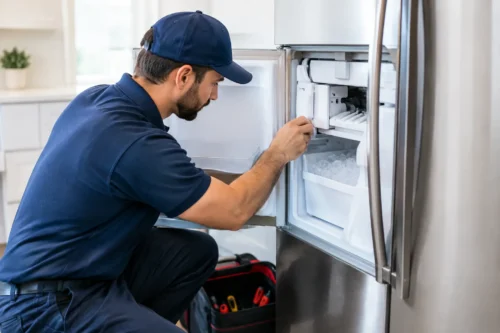
Repair is often the better choice when the appliance is still within a reasonable service life and the problem is clear and limited. Many common failures involve components that wear out over time, such as heating elements, igniters, drain pumps, door latches, belts, rollers, control boards, or ice maker parts. When the rest of the machine is sound, replacing the failed part can restore dependable performance without the cost and hassle of buying new.
For many households, repair also protects convenience. Replacing a built-in wall oven, a specific refrigerator size, or a matching laundry set is not always simple. Measurements, delivery delays, installation costs, and finish matching can turn what seemed like a quick purchase into a drawn-out project.
There is also a budget reality. A well-done repair is usually less expensive than full replacement, especially when the appliance was a quality model to begin with. In those cases, repairing can be the most practical way to extend the value of something you already own.
When replacement makes more sense
Sometimes replacement is the smarter call, even if a repair is technically possible. Age is a big reason. Older appliances tend to develop multiple issues close together. You may fix one failure only to face another a few months later. At that point, the problem is not just the current repair bill. It is the growing chance of repeated interruptions.
Replacement also becomes more attractive when parts are no longer available, when the unit has major internal damage, or when the repair approaches a large percentage of the cost of a new appliance. Safety matters too. If an appliance has electrical damage, gas-related concerns, or structural problems that affect reliable operation, replacing it may be the more responsible choice.
Efficiency can matter, but it should not be overstated. Newer appliances can use less water and energy, but those savings do not always justify replacing a machine that could be repaired affordably and continue working well for years. Efficiency should be one factor, not the only one.
Age matters, but not by itself
Homeowners often ask for a simple rule based on years. While average lifespan estimates can be helpful, they are not enough on their own. A 12-year-old dryer with one failed heating element may still be worth repairing. A 6-year-old refrigerator with repeated expensive problems may not be.
The better question is not just, “How old is it?” It is, “How old is it, what failed, and what condition is the rest of it in?”
A few practical patterns tend to hold true. Laundry appliances and dishwashers often remain good repair candidates when the issue is mechanical and the machine has otherwise been reliable. Refrigerators can be worth repairing too, but the answer depends heavily on which system failed. Cooking appliances often justify repair because many problems are isolated to specific serviceable parts. On the other hand, if corrosion, multiple control failures, or major compressor-related issues are involved, the decision may shift.
The 50 percent rule and why it is only a guide
You may hear that if a repair costs more than 50 percent of replacement, you should buy new. That can be useful as a starting point, but it is not a law.
If the appliance is only a few years old and the repair solves the issue fully, spending more than half of replacement cost may still be reasonable. If the appliance is old, unreliable, and the repair only addresses one of several concerns, even a lower repair bill may not be wise.
Think of the percentage rule as a shortcut, not a final answer. The real question is whether the repair buys you dependable time or only postpones the next breakdown.
Hidden costs homeowners often overlook
In appliance repair versus replacement decisions, the price tag is only part of the story. Replacement has extra costs that are easy to miss at first. Delivery, haul-away, installation, vent or water line adjustments, trim changes for built-in models, and time spent shopping all add up.
There can also be performance trade-offs. Not every new model is built to the same standard as older machines. Some homeowners replace an appliance expecting a major upgrade, only to discover the new unit has more sensitive electronics, longer cycle times, or fewer repairable components.
Repair has hidden costs too, especially if the appliance has become unreliable. Missed laundry days, food spoilage, hand-washing dishes, and constant uncertainty have real value. If a machine is disrupting daily life repeatedly, replacement may save more frustration than the sticker price suggests.
A practical way to make the decision
If you are stuck between repair and replacement, slow the decision down just enough to ask the right questions.
Start with the diagnosis. What failed, and is it a common repair or a sign of broader wear? Then look at the appliance’s history. Has it been dependable, or have you already spent money on recent service? Next, compare the repair estimate to replacement, including installation and any related costs. Finally, consider the impact on your household. A second refrigerator in the garage buys you time. A broken kitchen refrigerator in the middle of summer does not.
This kind of decision is easier when the advice is straightforward. A trustworthy technician should be willing to tell you when a repair is a good investment and when it is not. That honesty matters more than a sales pitch in either direction.
What homeowners usually regret
Most regret comes from making the decision too quickly. Some replace appliances that had years of life left because the first failure felt bigger than it was. Others keep repairing a unit that is steadily becoming less dependable because they want to avoid the upfront cost of replacement.
The better outcome usually comes from balancing today’s expense with tomorrow’s risk. If the repair is solid, affordable, and likely to restore reliable operation, repair often makes sense. If the machine is aging out, piling up issues, or creating safety concerns, replacement is usually the cleaner long-term move.
For homeowners in Southern Utah, where a failed refrigerator, freezer, washer, or oven can throw off the entire week, the goal is not just to spend less today. It is to make the choice that brings back dependable routine with the least waste, stress, and guesswork.
A good appliance decision should leave you feeling confident, not cornered. When you understand the condition of the machine, the true cost of each option, and the likelihood of future trouble, the next step becomes much clearer.